
A sector poised for transformation
Local authority sport and leisure functions are at a crucial point of change. With abundant financial pressures, sustainability expectations at an all-time high and the challenge of addressing widening public health inequalities, the sector has a responsibility to adapt and future-proof its facilities and services. The annual Association for Public Service Excellence (APSE) Sports and Leisure Seminar presented a timely forum to grapple with these issues, and the APSE State of the Market Survey provided a foundational evidence base for the discussion.
Leisure representatives and sector professionals came together to hear exclusive expert insights and fundamental findings of the latest APSE survey report, as well as a range of presentations from local authorities, public bodies and other leisure industry representatives.
Opened by Matt Ellis, Principal Advisor at APSE, he explained that the purpose of the seminar, named ‘Active Futures: From Facilities to Wellbeing’ was to “Explore how councils can reimagine leisure provision to deliver more than facilities alone, building healthier, more active and resilient communities.”
The State of the Market – a national snapshot
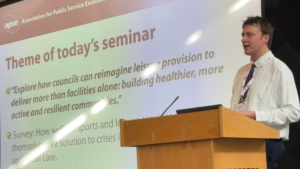
Surveying UK local authority and leisure teams, Ellis revealed that the APSE report provides a “valuable snapshot of the sector”, covering a diverse range of topics from pricing to facilities and infrastructure. The report adopts a comparative analysis where possible with previous surveys to identify key trends, as well as challenges, opportunities and issues that the sector is facing.
One of the biggest challenges that the leisure industry currently faces is financial sustainability and commercial viability. With a majority (55%) facilities either requiring refurbishment or deemed as ‘beyond economic repair’, there’s an increasing risk of a widespread facility crisis. Like every other industry, leisure operations have also had to adapt their services to reflect the increasing cost of provision – for example, a 27% rise in adult swim prices since 2023. What differentiates leisure is their steadfastness in protecting access to vulnerable groups via the upkeep of concession schemes. This balancing act between providing social value and commercial presence is making it evermore increasingly difficult to stay financially stable and provide the expected offering of a local authority facility.
A strategic asset: Building a valued workforce
With over 60% of those surveyed reporting trouble both in recruiting and retaining staff in non-managerial positions, the timely introduction of professional status and continued implementation of local skills plans from the Chartered Institute for the Management of Sport and Physical Activity (CIMSPA) becomes even more important.
Find out more about professional status
With local skills diagnostics taking place nationwide, local skills plans are being developed to ensure training provision is adequately reflective of the demand in sector recruitment in the respective area. As a result of these projects, CIMSPA works with the employer representative body and integrated care boards to unlock funding, receive funded training, and in turn upskill staff or recruit new staff to help deliver in those areas. Clare Dunn – Associate Director of Business Engagement at CIMSPA, also adds: “The other thing that it does is ensure that education is aligned with future workforce needs.”
Other elements of the local skills plan project highlighted, was its ability to locally tailor workforce development strategies to meet labour market needs, the enabling of employer-led curriculum in conjunction with CIMSPA and targeted funding to skills gaps.
Find out more about local skills
Since January, CIMSPA has worked alongside the Department for Work & Pensions to support jobseekers to build a great career in the sport and physical activity sector. The partnership supports individuals suitable for a sector-specific work academy placement which covers relevant essential skills such as first aid, customer service and work shadowing. Following this, through CIMSPA’s collaboration via their Workforce Development Team and local skills plans, regional education providers are guided to deliver targeted training to support learner progression and in turn, equip them with the skills and experience needed to enter and thrive in the sector workforce.
These DWP pilot schemes have created an entirely new recruitment channel through the nationwide connections CIMSPA has created and have been fundamental in activating economically inactive people through sport and physical activity roles. The scheme’s career support helps over 30,000 work coaches and over 130 DWP School Advisers to inspire individuals into a career in the sector.
Read more about the Employability Academy pilot
Aligning policies and embedding active wellbeing
For movement forwards to commence within the leisure industry, it has become evident that strategies must align with national policies and priorities to have impact. Whilst public leisure services are in a prime position to be recognised for their provision, by utilising national policy frameworks, the sector can help to justify investment amid competing budget demands.
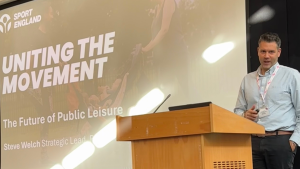
As the public health focus begins to shift onto active wellbeing, it is important that leisure services are taking a health-centric approach. Steve Welch – Strategic Lead for Leisure Operations at Sport England confirms this idea by stating that the current direction of travel consists of the alignment of leisure, physical health, mental health and social care. It is also moving to provision that is place-based, activating strategies for engaging inactive communities and addressing health inequalities.
Here arrives the perfect opportunity for local authorities to leverage partnerships with national bodies for strategic support. For example, Sport England’s ‘Uniting the Movement’ 10-year vision, which is one of the main key drivers within the sector that is aiming to raise participation levels.
Find out more about Uniting the Movement
Welch explains why the leisure industry is at a pivotal moment to leverage funding and collaboration: “Public leisure is uniquely placed to provide a service that just isn’t served in the private sector and elsewhere…You will not find the delivery of the swim programmes, development opportunities for engagement, social connection or health-related programmes – it’s just not incentivised in the private sector in the way it is in public leisure.”
Matt Ellis agrees and states that integrating leisure services into the health and social care system is key for the future: “Leisure is no longer a “nice-to-have” service but a core component of local public health infrastructure. With 97% of professionals agreeing its future lies in integration with health, the focus must be on embedding services with NHS and social care pathways and proving their value through robust outcomes data.”
The role of partnerships amongst local authorities, leisure operators, public health bodies, community organisations and other local stakeholders is fundamental to building resilience.
Reimagining the built environment
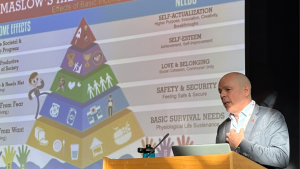
With approximately 2800 leisure facilities around the country, and 70-75% of these being over 25 years old, it is easy to understand why over half of them are in need of a revamp. As the time comes to ‘freshen-up’ these spaces, it is the ideal opportunity to look at redesigning them to meet a variety of hierarchical needs, prioritising community requirements and addressing socio-economic inequalities in planning facility provision. Designing for inclusivity ensures that facilities can serve minority and vulnerable groups such as older adults, disabled people and children as well as helping to break barriers in diverse communities. As presented by Space & Place’s CEO, Keith Ashton, reimagining public leisure spaces for communities has the potential to have great impact. By rethinking how leisure centres, wet side centres and those with outdoor spaces are used, local authorities and leisure providers can maximise community reach and make a real difference to lives.
Matthew Newens, Group Operations Manager Leisure & Southwater at Telford & Wrekin Council presented a fantastic case study of how they’re creating an inclusive leisure experience which welcomes individuals of all abilities, backgrounds and ages. Through their ‘Inclusive Leisure Partnership Action Plan’, the borough has invested in numerous developments which considers the whole user experience, as well as the more conspicuous improvements of provision.
The delivery includes having provided 172 leisure staff with disability awareness training and upskilling various instructors to provide access support. Communications improvements were made to increase overall accessibility within their marketing materials and website, as well as fundamental work to become a more inclusive leisure brand. Telford and Wrekin Leisure developed several inclusive physical activity programmes including ice skating, soft play and disability swimming sessions across the borough, as well as making an investment into dedicated accessible equipment, from communication boards to a bespoke accessible health and fitness facility.
Moving outdoors, to spaces such as Telford Town Park where adaptability and accessibility are at the forefront, featuring adaptive bikes available from Telford Bike Hub. Further provision improvements include accessible pathways within the nature trails and adventure golf as well as communication panels and accessible equipment in the play area.
Find out more about Telford & Wrekin Council’s leisure developments
Sustainable futures
As councils begin to rethink how their leisure facilities are used, now too has the time arrived for a reconsideration of funding and financial sustainability. One local authority taking the lead on transforming their in-house leisure provision, One Leisure, is Huntingdonshire District Council, who are reviewing their long-term operating model with the view of becoming more commercially sustainable and financially viable.
Following an independent strategic review in 2023, Gregg Holland, Head of Leisure Health and Environment, and Leigh Allaker, Business and Operations Manager at Huntingdon District Council revealed that the recommendations suggested several delivery changes. From switching up the membership architecture and developing an aquatic strategy to digital innovation and decarbonisation. With a fully-fledged development plan laying out the individual strategic drivers for change, once implemented the transformation outcomes began to speak for themselves. In years comparatively from 2022/23 to 2024/25, membership volume increased resulting in a 50% growth in membership income, as well as a 27% growth in swim school income.
These various improvements of provision and investment into facility development have taken One Leisure from financial loss to a sustainable, in-house model. Other practical ways in which costs are being controlled throughout local authority leisure provision is through decarbonisation and controlling energy costs – and therefore reducing environmental impact and extending building lifespan.
Changing the narrative
As an eye-opening session concluded, the ultimate message was clear: We need to change the narrative around sport and leisure. It needs to be viewed as the solution to the challenges of public health, mental health and social care. However, that’s not to say that the work hasn’t already begun. Matt Ellis brought the reality into the spotlight; leisure is “a sector under pressure but also innovating and gradually repositioning itself as a key part of health and wellbeing delivery.”
Going forwards, the three top priorities to drive the sector towards a sustainable future are:
- Budget – with a focus on commercial strategy and financial sustainability
- Facilities – with the need to be more multi-functional, serving vulnerable populations and increasing social value, as well as practicing environmental stewardship
- Workforce – with an emphasis on identifying and fulfilling skills gaps
This is a time for resilience, innovation, boldness, and cross-sector collaboration. By embracing these themes, the sector can truly future-proof its role in shaping healthier, more equitable communities.